The Skill AI Can't Shortcut
Reading time: 9 minutes
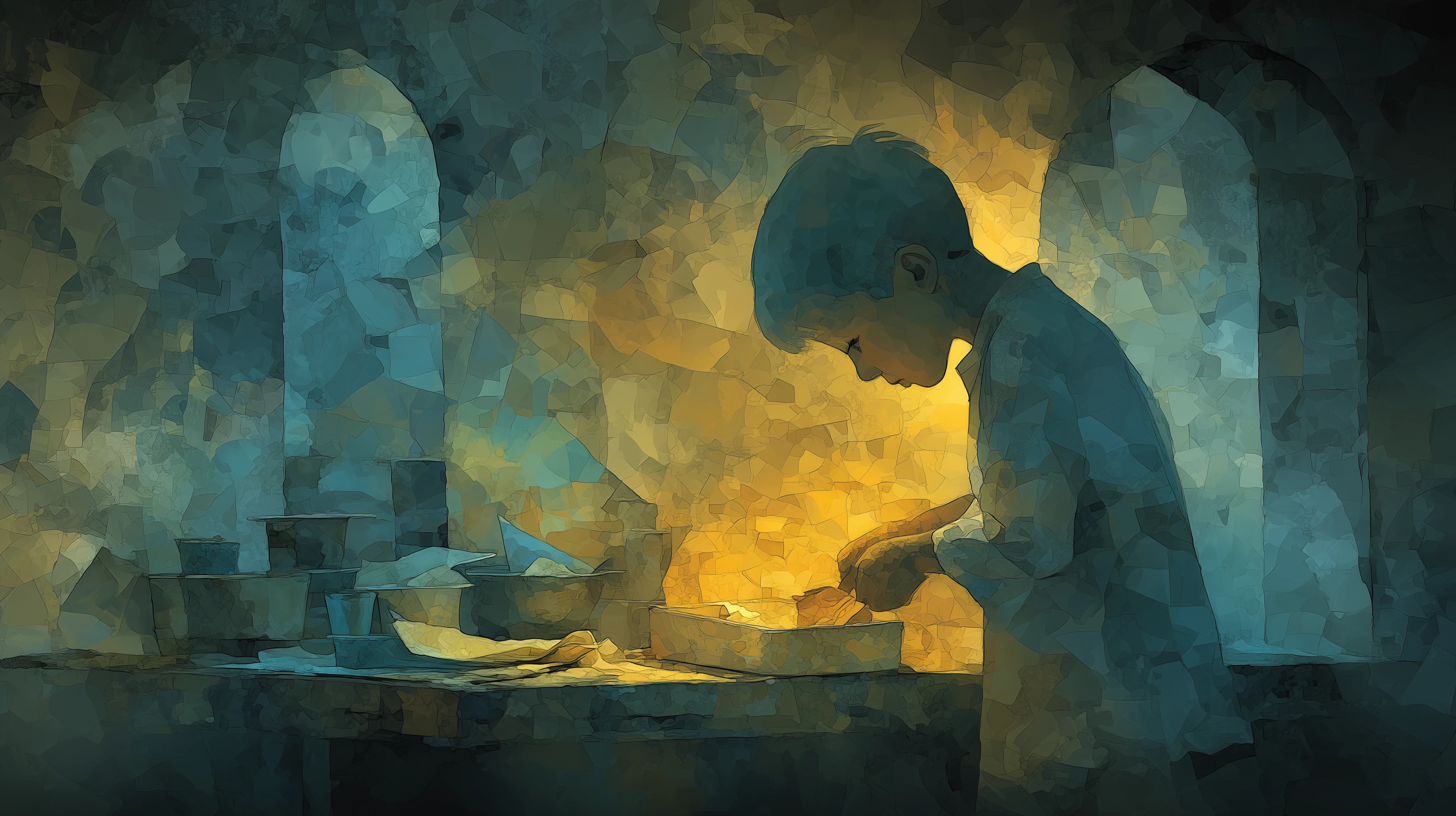
A nine-year-old stands at the threshold of a forge. The repair she needs to make requires a specific cantrip, and the cantrip has a rhythm she can't quite master yet.
She tries it. Loses the rhythm halfway through. The forge stays broken. She tries again, loses it earlier. Third attempt, she gets further, drops it on the final beat.
She sets her jaw. The forge is right there. She knows the cantrip. She's almost had it twice now. She tries a fourth time. She finds something in her hand, in her ear, in her timing that wasn't there ten minutes ago. The cantrip lands. The forge takes the spell. The world is a little more whole.
She held attention through frustration. She built the ability to hear and hold music in her mind. She experienced fiero, the deep pride that comes from doing a hard thing yourself, without someone shortcutting it for you. And the next hard thing she meets, in Grit or anywhere else, starts with that muscle memory: I have done hard things before. I can do this.
What the Future of Work Actually Requires
Think about what you want for your child at 25. Not a job title. Something underneath that. You want them to be resourceful. Curious. Able to sit with a hard problem and actually work through it.
The World Economic Forum's 2025 Future of Jobs report ranks creative thinking as a top-four required skill. By 2030, 39% of workers' core skills are projected to change.
At the same time, AI makes it easier than ever to get through things without learning them. A child can produce an answer, finish a worksheet, complete an assignment, and walk away having practiced nothing. Creative problem solving and critical thinking don't work that way. You can't generate your way to them. You have to build them, slowly, by doing hard things and staying in the room when they don't go right.
What Schools Keep Getting Wrong
While arts and music education are reliable builders of creative capacity, they're consistently the first areas schools cut when something else takes priority. A 2011 National Endowment for the Arts study found the cuts have been deeply uneven — between 1982 and 2008, childhood arts education fell 49% for African American children and 40% for Hispanic children, against just 5% for white children.
When standardized test scores became the measure of every school's success, time for everything else got squeezed.
The squeeze hit hardest on the subjects whose value compounds. Music doesn't pay off this quarter. Reading for understanding doesn't pay off on next month's benchmark. Math you actually use, the kind that lives inside a real problem rather than a memorized procedure, doesn't show up on a multiple-choice test. So schools optimized for what gets measured. And the kids whose families couldn't afford private music lessons or summer reading enrichment lost the most.
With AI able to finish assignments on demand, the gap keeps widening. Tools that can complete the work without the child practicing it are the path of least resistance for students already running short on time. The kid who uses AI to finish their book report skips the focus, patience, and problem-solving the assignment was designed to build.
Three Disciplines, Three Ways In
Grit is built around three disciplines: musicianship, literacy, and math. Each one builds a different facet of creative problem solving. None of them have a shortcut.
Musicianship: No Shortcut to the Rhythm
The world of Grit is broken. Your child repairs it by casting cantrips, learning a melody, finding the rhythm, and mastering the rhythm. If they lose the rhythm, they go again. They keep going until they master it, the spell takes, and part of the world is restored.
That practice builds audiation: the ability to hear and understand music in your mind before you play it. Mastery develops through practice, passion, and perseverance. There's no other way in.
We wrote a longer piece on the cognitive science behind audiation, why it's the skill behind every truly musical child, and what the research says about how it develops.
Literacy: Words You Have to Prove You Know
Grit is a text-based world. Your child has to read it to navigate it.
As they read, magical shimmer appears over certain words. Gleaning it earns them currency in the world, but only if they're actually reading and understanding what's in front of them. Their fae familiar Wisp asks them to define or describe words they've encountered, proving mastery rather than just recognition. Parents can upload vocabulary words to weave directly into the story. And as your child demonstrates real comprehension, the game advances automatically. Harder words, richer challenges, more of the story within reach.
A child reads because reading is how they explore the world. The vocabulary doesn't sit in a flashcard deck. It sits inside Wisp's questions, the next room your child wants to enter, the next character whose dialogue suddenly makes sense. Comprehension stops feeling like a test and starts feeling like the point.
Wisp doesn't take "yes" for an answer. AI tutoring tools that don't require demonstration, the ones that ask "did you understand?" and accept "yes" as evidence, skip the step that actually builds the skill. The child has to use the word back, in their own sentences, in a way the system can verify. That small loop, repeated thousands of times across thousands of words, is what builds a reader.
Math: Real Problems, Not Problem Sets
Most educational games pull your child out of the story for a math problem, then drop them back in when it's done. The problem is solved, the experience continues, and almost nothing transfers. The child learned to do the problem set in front of them, not to think mathematically when math was needed.
In Grit, math shows up the way it does in real life: as something your child needs in order to do what they're trying to do.
The entire crafting system, how your child repairs things and contributes to the town, runs on it. Measuring materials. Combining them in correct ratios. Working with physics to cast cantrips that depend on understanding scale, force, or proportion. The math isn't separate from the challenge. It's inside it.
A child who has spent thirty hours measuring, combining, and reasoning their way through Grit's crafting system has built a different relationship with math than one who has spent thirty hours on practice problems. They know what math is for. They've used it to make something they cared about. That's what makes it stick.
What We Measure, and What We Ignore
What We Don't Measure
Most games are designed to keep your child in the app as long as possible. Every design decision, every reward loop points toward more time on the platform. We don't optimize for time-on-platform. We cap sessions at 25 minutes, then suggest kids step away. That's intentional. Twenty-five minutes of focused practice followed by a break is how learning actually consolidates. Their brain keeps processing while they're doing something else entirely. That's when practice turns to skill.
We want kids to go outside, play in real life, let the practice settle. That offline time matters so much to us that we're building toward in-game rewards for real-world practice, actually playing an instrument, reading a book, doing something hard away from a screen. We built Grit to make mastery feel like something worth pursuing.
What We Do Measure
As your child demonstrates capability, the game up-levels the challenges they face. We track a mastery score in each discipline so we can measure real improvement over time. Parents get a dashboard view of those scores so you can track your child's progress yourself. The goal is to keep kids in the zone where the next thing is a little hard, but not so hard they quit and not so easy they check out.
These are slower metrics. They don't move every session. They're designed to tell you, over weeks, whether the practice is doing what practice is supposed to do. Whether the hard things are getting a little easier.
What AI Is For
Grit is AI-native because AI is part of how the world already works. The skill we're trying to build isn't avoidance. It's agency: knowing when to lean on AI guidance and when to trust your own thinking instead.
AI is excellent at patience. It can ask the same question forty different ways without losing its temper. It can wait while your child thinks. It can adjust its difficulty in real time.
AI is dangerous as a surrogate. When a child should have been the one to find the rhythm, parse the sentence, or work the math, and AI does it for them instead, the developmental window closes.
In Grit, AI shows up as a guide, a witness, a patient companion. It doesn't show up as a finisher.
McGraw Hill's incoming CEO made a related argument in Fortune this spring: "Learning isn't a data problem. It is physical, social, and emotional, shaped by age, culture, and even what happened at recess." The skills that matter most are the ones built through real effort and real emotion — exactly the ones AI can scale alongside, but not stand in for.
One Child, One Hard Problem
When that nine-year-old lands the cantrip, she doesn't get a trophy screen. The forge is repaired. The town is a little more whole. She moves on to the next thing the world needs from her.
It's the pattern we watch, repeatedly, across our founding families. A child at the edge of what they can do. A design that refuses to rescue them. A small victory that belongs entirely to them.
Jane McGonigal's research on fiero shows it's one of the most powerful motivators in sustained engagement and learning. It's also the emotion most educational software destroys by making things too easy, or by letting the AI finish the hard part.
Every child who plays Grit encounters that forge moment in some form. The spell that won't quite hold. The word Wisp keeps asking about. The ratio that needs one more try. Grit is designed to make those moments worth having.
Why This Matters Right Now
The jobs that will matter are the ones that require figuring out what instructions don't exist yet. AI can scale alongside that capability. It can't replace it.
The kids who'll be ready for that world practiced staying in the room when things didn't go right. They built things they cared about and had to think their way through. They trained their ear to hear music before they played it, built vocabulary through proof, and developed mathematical reasoning through real problems.
That practice only happens in environments designed to take it seriously.
That practice starts with one forge, one cantrip, one child who stayed in the room.
Want to see Grit in action? Join our Founding Families program and be part of building something your child will actually want to come back to. Apply to join the Founding Families.